
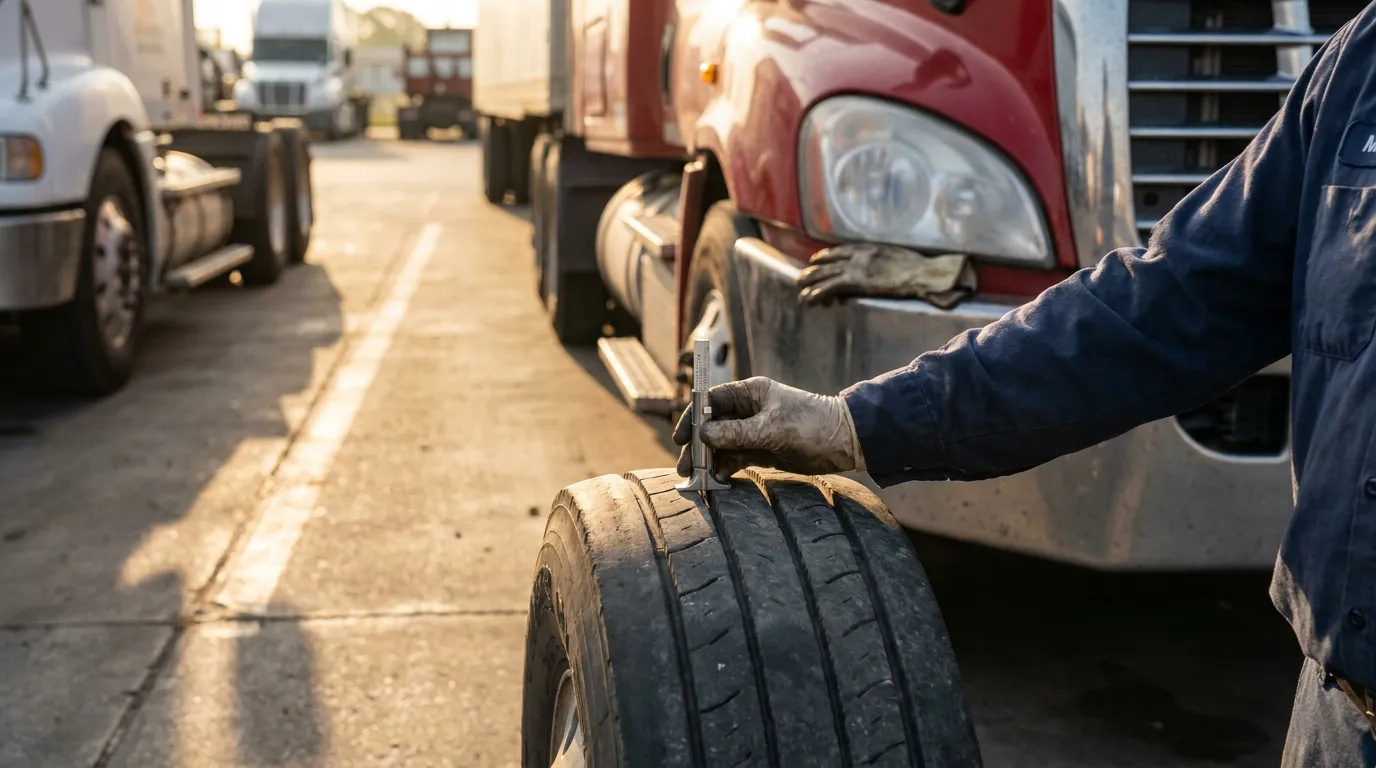
Why Steer Tire Tread Depth Matters So Much After an 18-Wheeler Blowout
Key Takeaways: The 4/32-inch steer tire rule is a federal standard under 49 C.F.R. § 393.75 requiring tires on the front wheels of a bus, truck, or truck tractor to have at least 4/32 of an inch of tread groove depth, double the 2/32-inch minimum for other tire positions, because steer tire failure is far more likely to cause a loss of vehicle control. In a Houston truck blowout case, a measurement below that threshold can serve as evidence of negligence against the carrier, driver, or maintenance provider, though it does not automatically establish liability. Texas adds its own duties through Transportation Code § 647.012 and Chapter 548 inspection requirements, and prior roadside inspection violations may help show a pattern of neglect. Building a claim depends on preserving the failed tire and related records quickly, since carriers often take possession within days, and on pairing the tread measurement with maintenance files and reconstruction testimony on causation. Texas generally allows two years to file under Civil Practice and Remedies Code § 16.003, with narrow exceptions and shorter notice deadlines for claims involving governmental units. Common defenses include framing the blowout as unavoidable and shifting comparative responsibility to the injured driver.
When a tractor-trailer’s front tire explodes at highway speed, the driver can lose steering control almost instantly, and the results on I-45 or the 610 Loop are often catastrophic. The 4/32-inch steer tire rule requires any tire on the front wheels of a bus, truck, or truck tractor to have a tread groove depth of at least 4/32 of an inch, twice the 2/32-inch minimum applied elsewhere, reflecting the heightened risk that steer tire failure causes loss of vehicle control. In a Houston blowout case, proof that a steer tire fell below that threshold may become important evidence of negligence against the carrier, driver, or maintenance provider, but it is only one part of the analysis.
If you or someone you love was hurt when a commercial truck’s tire came apart, the team at Payne Law Firm can help you understand what the evidence may show. Call 713-223-5100 for a free consultation, or contact us now to speak with someone who will treat you like family, not a file number.
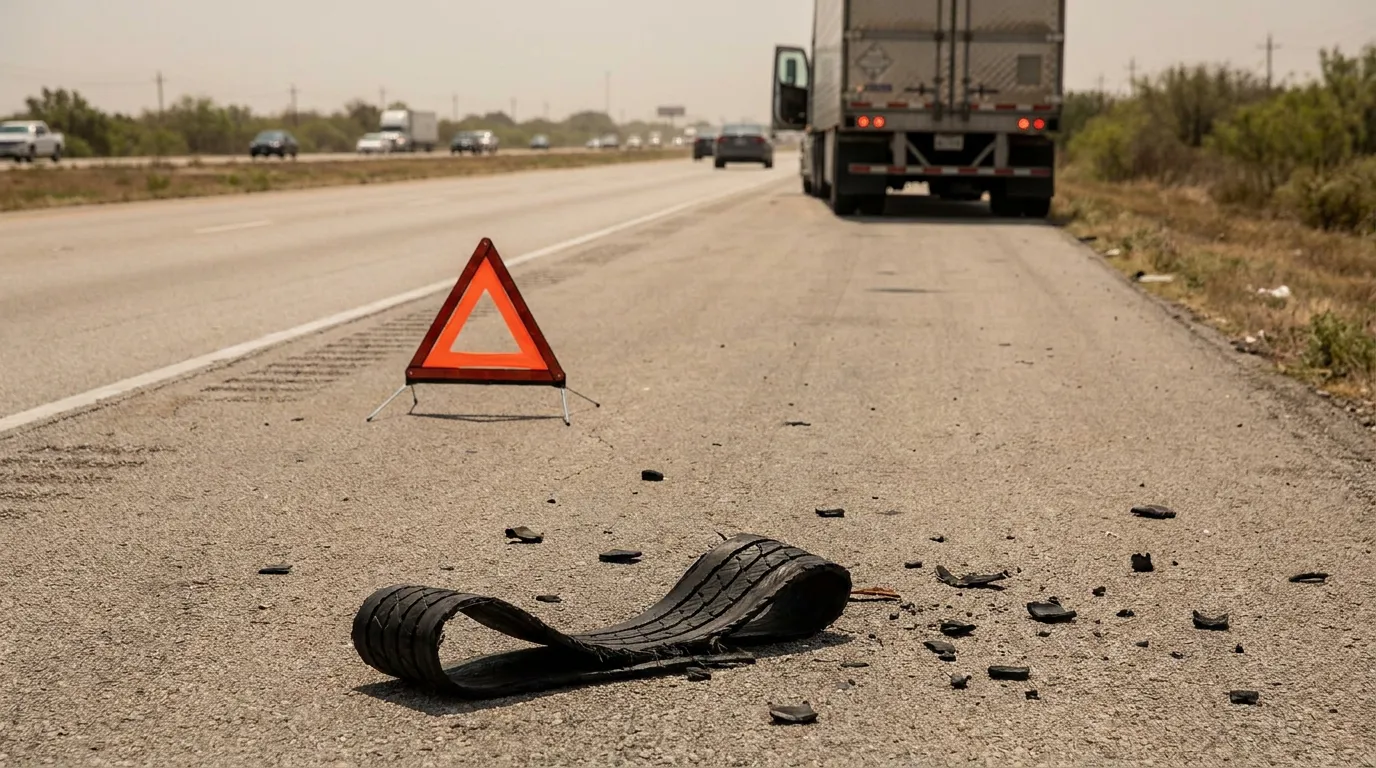
The Federal Rule Behind Truck Tire Blowout Accident Liability Houston Families Rely On
The controlling standard comes from the Federal Motor Carrier Safety Regulations at 49 C.F.R. § 393.75, which Texas has adopted by reference and enforces against commercial vehicles operating in and through the state. Under the commercial vehicle tire standards published by the Texas Department of Public Safety, any tire on the front wheels of a bus, truck, or truck tractor must have a tread groove depth of at least 4/32 of an inch measured at any point on a major tread groove, while other positions generally require at least 2/32 of an inch. Section 393.75 also prohibits operating with flat, leaking, or otherwise unsafe tires regardless of tread depth.
A parallel federal inspection standard reinforces the same distinction. Under 49 C.F.R. § 393.75(b)-(c), the federal motor carrier safety regulations separate steering axle tires (requiring 4/32 inch tread depth on front wheels of buses, trucks, and truck tractors) from other tires (requiring 2/32 inch), and specify that measurements "shall not be made where tie bars, humps, or fillets are located." The parallel vehicle in-use inspection standard at 49 C.F.R. Part 570, Subpart B, § 570.62(a) similarly requires 4/32 inch on front tires and 2/32 inch on all other tires. Part 570 governs state in-use inspection programs rather than an independent carrier duty, but its measurement details matter later, since they shape how an inspector or reconstructionist verifies compliance after a crash.
Texas law layers additional duties on top of the federal floor. Texas Transportation Code § 647.012 requires tires to be of adequate capacity for the vehicle’s gross weight, to have tread contacting the road, to not be so smooth as to expose tread fabric, and to be free of a defect likely to cause failure. Chapter 548 separately directs DPS to adopt an inspection program consistent with federal motor carrier safety regulations and requires Texas-registered commercial vehicles to pass an annual safety inspection.
Tread Depth Requirements at a Glance
| Tire Position | Minimum Tread Depth | Primary Authority |
|---|---|---|
| Steer axle (front) tires | 4/32 inch | 49 C.F.R. § 393.75; 49 C.F.R. § 570.62(a) |
| All other tire positions | 2/32 inch | 49 C.F.R. § 393.75; 49 C.F.R. § 570.62(a) |
| Any position, Texas general rule | No exposed tread fabric; no defect likely to cause failure | Tex. Transp. Code § 647.012 |
How a Steer Axle Tire Failure Becomes Evidence of Negligence
A regulatory violation does not automatically win a case, but it can be meaningful proof. In Texas, an unexcused violation of a safety statute may be treated as negligence per se when the injured person belongs to the class the rule was designed to protect and the injury is the type the rule was meant to prevent; otherwise, the violation is simply some evidence of negligence. Even where negligence per se applies, the claimant must still prove proximate cause and damages. A measured tread depth of 2/32 of an inch on a steer tire, standing alone, does not establish liability, but paired with maintenance records, inspection reports, and reconstruction testimony, it may become central to a claim.
Texas law also imposes duties on the driver. Texas Transportation Code § 547.004 makes it a misdemeanor offense to operate or move, or as an owner knowingly permit another to operate or move, a vehicle that is unsafe so as to endanger a person or that is improperly equipped in violation of Chapter 547 standards, and federal regulations at 49 C.F.R. §§ 392.7 and 396.13 require a driver to confirm the vehicle’s equipment, including tires, is safe before driving. A driver who skipped or rushed a pre-trip inspection may have missed visible tread wear, which may support a claim against the driver and, through vicarious liability or direct negligence theories, against the employer.
Roadside inspection history frequently tells the real story. Texas DPS Commercial Vehicle Enforcement applies FMCSA tire standards during inspections, and prior out-of-service violations for worn tires may suggest a pattern of neglect. Prior citations may support arguments about negligent maintenance, negligent supervision, or corporate indifference to safety, though admissibility is decided by the court and is not guaranteed.
Who May Be Responsible in a Houston Truck Blowout Case
Liability is rarely limited to one party. Depending on the investigation, potentially responsible parties may include:
- The driver, for failing to conduct or act on an adequate pre-trip inspection
- The motor carrier, for inadequate maintenance programs, pressure to keep trucks rolling, or failure to enforce inspection policies
- A third-party maintenance or tire service company that inspected, repaired, or replaced the tire
- The tire manufacturer or retreader, if a manufacturing or design defect contributed
- The trailer owner or lessor, under certain contractual and regulatory arrangements
When a repair shop or fleet vendor touched the tire before the crash, our discussion of how to prove a maintenance contractor’s fault walks through the documentation that often makes or breaks those claims.
Evidence That Preserves a Tread Depth Claim
The physical tire is often the most important piece of evidence, and it can disappear fast. Carriers and insurers frequently take possession of the failed tire, wheel assembly, and tractor within days. Once discarded, retreaded, or "inspected" without your side present, it becomes far harder to prove the actual tread depth at the moment of failure.
A spoliation letter sent early can change a case’s trajectory. Counsel can demand preservation of the tire, maintenance and repair invoices, driver vehicle inspection reports, roadside inspection records, ECM data, dashcam footage, and dispatch communications. Under Texas law, a court may impose a remedy only after finding a party with a duty to preserve evidence breached that duty, considering the degree of prejudice; a spoliation jury instruction is reserved for narrow circumstances like intentional destruction.
💡 Pro Tip: Photograph the truck’s front tires from multiple angles at the scene if safe, including close shots of tread grooves and sidewall damage. These images are sometimes the only contemporaneous record of tread condition before the vehicle is moved.
Reconstruction analysis connects the tread measurement to the crash. A reconstructionist may examine tire carcass fragments, wear patterns, evidence of underinflation or overloading, and the vehicle’s path after failure. Causation remains a distinct legal element, and a defendant may argue road debris, a sudden puncture, or another driver’s conduct caused the failure rather than worn tread.
The Filing Deadline You Cannot Afford to Miss
Texas generally imposes a two-year deadline for personal injury and wrongful death claims under Civil Practice and Remedies Code § 16.003. Deadlines can vary by claim type and defendant, and missing one is typically a complete defense.
Exceptions exist, but courts interpret them narrowly. Tolling based on minority or legal incapacity under § 16.001, the discovery rule, or a defendant’s absence from the state may extend a deadline in limited, fact-dependent situations. Claims against a governmental unit are different: the Texas Tort Claims Act generally requires formal notice within six months, or sooner under a city charter, separate from the civil statute of limitations. Because deadlines can turn on non-obvious details, it’s wise to have the timeline evaluated promptly.
Practical Challenges Injured Houstonians Often Face
Insurers frequently frame a blowout as unavoidable, tires fail, debris punctures rubber, nobody is at fault. That framing leaves out the regulatory obligation to inspect, measure, and remove tires below the federal minimum. Documented compliance failures can undercut that narrative.
Comparative responsibility is another common defense tactic. Under Texas Civil Practice and Remedies Code Chapter 33, a claimant whose responsibility exceeds 50 percent may not recover at all, and a claimant 50 percent or less responsible has recovery reduced by that percentage. Defense counsel may argue a following driver had time to react to tire debris; careful reconstruction and witness work may help address those arguments.
Catastrophic injuries complicate valuation. Medical expenses, future care needs, lost earning capacity, pain, mental anguish, and wrongful death remedies each require separate proof, and early settlement offers rarely account for care not yet provided. A Houston truck accident lawyer can help evaluate whether an offer reflects the full scope of documented losses.
Frequently Asked Questions
1. Does a 4/32-inch violation automatically prove the trucking company was negligent?
No. Depending on the facts, a violation may be treated as negligence per se or as evidence of negligence, but a claimant must still prove causation and damages, supported by expert analysis.
2. What if the blowout involved a rear tire instead of a steer tire?
Rear and trailer tires are generally subject to the 2/32-inch minimum. A rear tire failure may still support a claim under § 393.75 or Texas Transportation Code § 647.012 if the tire had a defect likely to cause failure or exposed tread fabric.
3. How can I find out whether the truck had prior tire violations?
Roadside inspection records maintained through federal and state enforcement systems often document prior tire citations. Counsel can request these records along with the carrier’s internal maintenance files during discovery, subject to applicable rules.
4. Can I still pursue a claim if the tire was destroyed after the crash?
Possibly. Maintenance invoices, inspection reports, photographs, witness testimony, and debris analysis may support the claim, and a court may impose a remedy for spoliation if the party had and breached a duty to preserve evidence. Outcomes depend heavily on the facts.
5. Who pays if a third-party repair shop serviced the tire?
Multiple parties may share responsibility. Contracts, work orders, and inspection documentation generally help determine whether a maintenance contractor, the carrier, or both bear liability, and a jury may apportion responsibility among them under Chapter 33.
Turning a Tread Measurement Into Accountability
The 4/32-inch steer tire rule exists because worn front tires put everyone on Houston’s highways at risk. Proving a truck tire violation generally requires moving quickly to preserve the tire, obtaining maintenance and inspection records, and pairing the measurement with credible causation analysis. No two cases resolve the same way, and the strength of any claim depends on the specific evidence available.
For more than 20 years, Attorney Jason E. Payne, a Port Arthur native who is Board Certified in Personal Injury Trial Law by the Texas Board of Legal Specialization, has helped over a thousand injured individuals and families pursue compensation for their losses. Reach out to Payne Law Firm today by calling 713-223-5100 or schedule your free consultation, and let us explain your options clearly and without pressure.
Disclaimer: This content is for informational purposes only and is not legal advice. Every case is unique, and results may vary. Consult an attorney about your specific circumstances.