
Why the Level of a Spinal Cord Injury Shapes Everything That Follows
Key Takeaways: The level of a spinal cord injury often influences lost function, lifetime care needs, and how a Houston paralysis claim is valued. Cervical injuries (C1 to C8) typically affect all four limbs and sometimes breathing, often producing the highest care costs, while thoracic injuries typically spare the arms and lumbar or sacral injuries may involve partial paralysis, chronic pain, or bowel and bladder loss. Completeness of the injury can matter as much as level, since two people with identical fractures may have very different prognoses. Texas law defines economic damages under Tex. Civ. Prac. & Rem. Code § 41.001(4), caps noneconomic damages only in health care liability claims under § 74.301, and generally bars recovery under § 33.001 when a claimant is found more than 50 percent responsible. Workplace paralysis follows a separate track, with lifetime income benefits potentially available under Tex. Lab. Code § 408.161 for permanent and complete paralysis and, where an employer is a non-subscriber, a possible direct negligence lawsuit against that employer. Strong life care plans, vocational assessments, and consistent medical documentation are generally what help support real claim value.
The height at which a spinal cord is damaged generally determines how much function a person loses, how much lifetime care they will need, and how a Houston paralysis claim is valued and litigated. An injury at the cervical spine can affect breathing, arm function, and bladder control, while an injury lower in the thoracic or lumbar region may leave the arms and hands intact. That difference can drive life care planning, lost earning capacity calculations, and the categories of damages Texas law allows a jury to award.
If you or a family member is facing life after a paralyzing crash, you do not have to sort through these questions alone. Payne Law Firm has spent more than 20 years helping injured Houstonians feel heard, informed, and respected during some of the hardest moments of their lives. Call 713-223-5100 or schedule your free consultation to talk with someone who will treat you like family.
Understanding Paraplegia vs Quadriplegia in Texas Injury Claims
The distinction between paraplegia vs quadriplegia comes down to how many limbs are affected, which generally depends on injury level. Paraplegia generally involves impairment of the legs and, depending on level, the trunk, and typically results from damage at or below the thoracic spine. Quadriplegia, also called tetraplegia, involves all four limbs and generally results from cervical-level damage.
Within each category, completeness can matter as much as level. A "complete" injury means no motor or sensory function below the level of injury, while an "incomplete" injury preserves some signal. Two crash victims with identical C6 fractures can have dramatically different prognoses, which is why treating physicians, not insurance adjusters, should be driving the medical narrative in your file.
Cervical Injuries (C1 to C8)
High cervical injuries may require ventilator support and around-the-clock attendant care, while lower cervical injuries may preserve partial arm and hand movement. Because these claims must account for decades of skilled nursing, home modification, adaptive equipment, and repeated hospitalizations, they typically carry the highest documented economic losses.
Thoracic Injuries (T1 to T12)
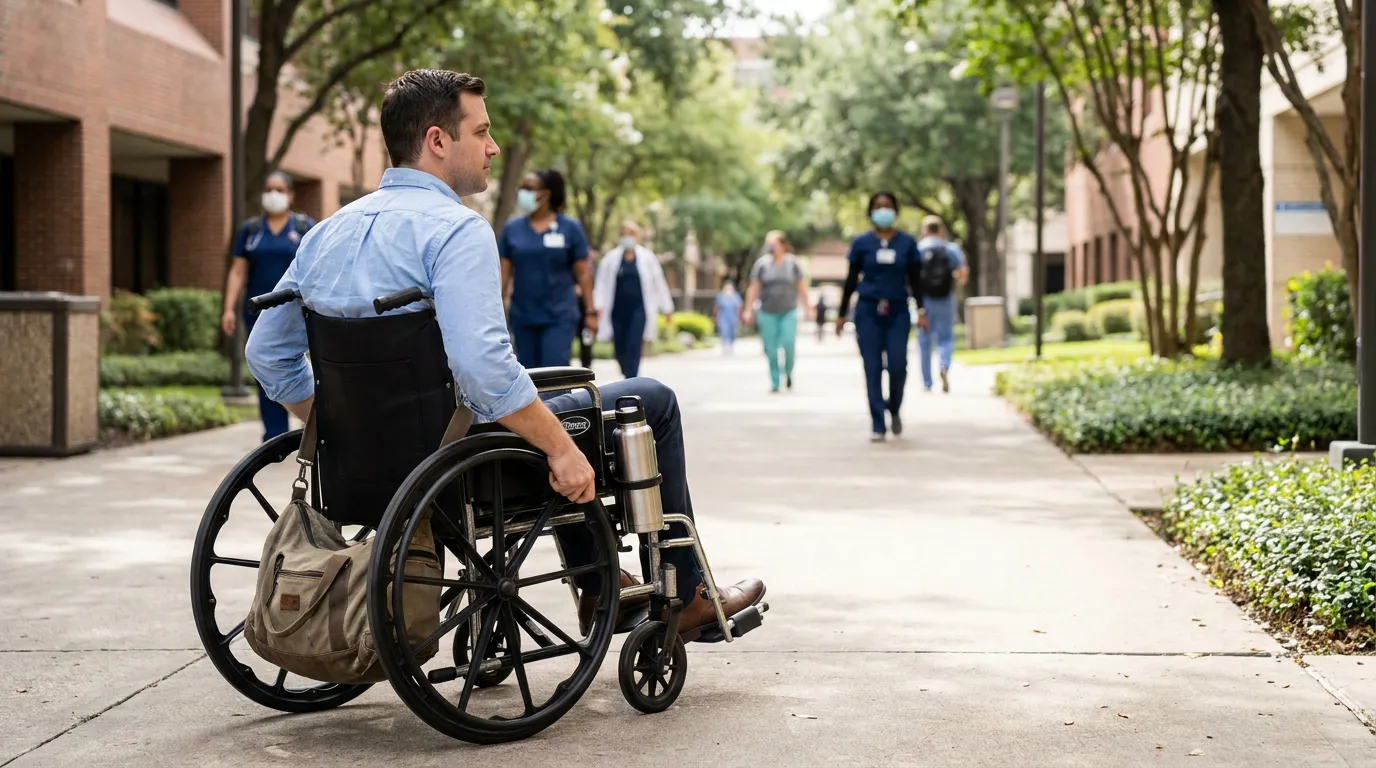
Thoracic injuries generally spare the arms and hands while affecting the trunk and legs. Many people with thoracic-level paraplegia regain significant independence with a manual wheelchair and can return to modified work. This comparison often becomes a central litigation dispute, since insurers may argue preserved upper-body function reduces future care needs.
Lumbar and Sacral Injuries (L1 to S5)
Lower-level injuries affect the hips, legs, bowel, and bladder to varying degrees. A lumbar spinal injury claim in Houston may involve partial paralysis, chronic neuropathic pain, or loss of bowel and bladder control rather than total loss of leg function. These cases are frequently undervalued early because the outward presentation looks less dramatic, even though the long-term functional and vocational impact can be profound.
| Injury Level | Commonly Affected Function | Typical Care Profile |
|---|---|---|
| C1 to C4 | Breathing, all four limbs | Ventilator support, 24-hour attendant care |
| C5 to C8 | Arms and hands, legs, trunk | Daily attendant care, powered mobility |
| T1 to T12 | Trunk and legs | Manual wheelchair, home modification |
| L1 to S5 | Hips, legs, bowel, bladder | Bracing, therapy, possible partial ambulation |
Individual outcomes vary considerably and depend on completeness of injury and medical factors unique to each person.
How Texas Law Measures Damages After Paralysis
Texas defines the financial side of a claim through statute rather than guesswork. Under Tex. Civ. Prac. & Rem. Code § 41.001(4), the definition of economic damages covers compensatory damages for actual economic or pecuniary loss, including medical expenses and loss of earning capacity, while excluding exemplary and noneconomic damages. In a high-level spinal cord case, those figures are often built from a life care plan and vocational assessment rather than existing bills alone.
Noneconomic damages sit in a separate category with different rules. Texas caps noneconomic damages in health care liability claims under Tex. Civ. Prac. & Rem. Code § 74.301, generally limiting recovery to $250,000 per claimant against physicians and non-institutional providers, $250,000 per health care institution, and no more than $500,000 in the aggregate against health care institutions. A separate provision, § 74.303, sets a different limit in wrongful death and survival actions. Those caps generally do not apply to ordinary negligence claims such as a car crash lawsuit, a point worth understanding when comparing catastrophic injury valuation figures online.
Texas also recognizes that catastrophic cases can move differently through the courts. Tex. Civ. Prac. & Rem. Code § 16.001 tolls the limitations period while a person is under a legal disability such as unsound mind, and settlements involving an incapacitated adult or a minor ordinarily require court approval and may involve appointment of a guardian ad litem. Understanding what qualifies as a catastrophic injury helps families anticipate the procedural attention these claims may receive.
💡 Pro Tip: Ask your treating team for a written functional capacity evaluation and a formal life care plan early. These documents often carry more weight with insurers and juries than narrative testimony alone.
Fault Allocation Can Reduce Recovery Regardless of Severity
Texas follows a modified comparative negligence rule, and severity does not soften it. Under Tex. Civ. Prac. & Rem. Code § 33.001, titled Proportionate Responsibility, a claimant may not recover damages if their percentage of responsibility is greater than 50 percent. If a jury assigns a plaintiff 20 percent of the fault, the award is generally reduced by that same share under § 33.012.
This is why insurers often invest heavily in fault arguments in paralysis cases. The doctrine of comparative negligence measures fault on a percentage basis and reduces recovery accordingly, and jurisdictions differ on how they structure their modified comparative negligence rules. In Texas, the statutory bar applies when a claimant’s responsibility exceeds 50 percent, placing Texas among the many states that follow a 51% bar rule, which makes evidence preservation, scene documentation, and prompt witness statements especially important. Responsibility may also be allocated to settling parties and, in some cases, to designated responsible third parties.
Practical steps that may help protect a claim include:
- Photographing the scene, vehicle damage, and roadway conditions when possible
- Requesting preservation of any commercial vehicle telematics or dashcam data
- Keeping every medical record, therapy note, and equipment receipt
- Declining recorded statements to an adverse insurer until you have counsel
- Documenting daily functional limitations in a written journal
When a Paralyzing Injury Happens on the Job
Workplace spinal injuries follow a different track, and Texas is unusual here. Unlike most states, Texas does not require most private employers to carry workers’ compensation insurance, though certain employers, such as public entities and some government contractors, face different requirements. Employees of a non-subscriber employer may need to pursue a personal injury lawsuit against the employer instead of filing a comp claim, which changes both the proof required and the damages available. The employee must still prove the employer’s negligence, but the employer loses the common-law defenses of contributory negligence, assumption of the risk, and the fellow-servant rule under Tex. Lab. Code § 406.033. Where an employer carries coverage, workers’ compensation is generally the exclusive remedy against that employer, subject to narrow exceptions such as a wrongful death claim based on gross negligence or intentional injury.
For covered workers, the Labor Code separates routine impairment from catastrophic loss. Tex. Lab. Code §§ 408.121 through 408.123 provide impairment income benefits calculated from an impairment rating assigned under the applicable edition of the AMA Guides. Tex. Lab. Code § 408.161(a) lists qualifying catastrophic injuries for lifetime income benefits and provides that those benefits are paid until the death of the employee, including for a spinal injury resulting in permanent and complete paralysis of both arms, both legs, or one arm and one leg. Subsection (b) provides that, for purposes of subsection (a), the total and permanent loss of use of a body part is the loss of that body part.
The level and completeness of the injury can therefore affect the benefit tier. A complete cervical injury may meet the lifetime income benefits threshold, while an incomplete lower-level injury may be routed to time-limited impairment income benefits instead. These administrative determinations are made through the Division of Workers’ Compensation and are separate from any civil lawsuit, and a third-party claim against a negligent driver may proceed alongside them, subject to the carrier’s statutory subrogation rights.
Building the Record That Supports Real Value
Spinal cord injury settlement factors generally extend well beyond the initial hospital bill. Insurers evaluating these claims typically look at documented future medical costs, attendant care hours, home and vehicle modification estimates, vocational loss, and the credibility of the treating providers. Gaps in treatment or inconsistent documentation can undercut an otherwise strong case.
Support services can also matter to long-term quality of life. Disability Rights Texas provides free legal services statewide for Texans with disabilities, including work on abuse and neglect investigations and advocacy for accessible communities. Eligibility and case acceptance depend on the organization’s own criteria and priorities. Those resources address needs that a civil claim alone may not reach.
Experience with catastrophic collision litigation can make a meaningful difference in how these files are built. Attorney Jason E. Payne is Board Certified in Personal Injury Trial Law by the Texas Board of Legal Specialization and has been recognized in Texas Super Lawyers from 2019 through 2026. Anyone searching for a Houston spinal cord injury lawyer should ask directly about how a firm develops life care evidence.
💡 Pro Tip: Do not accept an early settlement offer before your medical condition has stabilized. Paralysis-related complications often emerge months later, and most releases are final. Keep the statute of limitations in mind as well, since Texas generally allows two years from the date of injury to file suit.
Frequently Asked Questions
1. Does a cervical injury automatically mean a larger recovery than a thoracic one?
Not automatically. Higher-level injuries generally involve greater care needs and higher economic damages, but recovery depends on liability, available insurance coverage, completeness of the injury, and the individual’s age and earning history.
2. How is paralysis claim value in Houston actually calculated?
Valuation generally combines documented economic damages under Tex. Civ. Prac. & Rem. Code § 41.001(4) with noneconomic damages for physical pain, mental anguish, disfigurement, and physical impairment. Life care plans, vocational reports, and medical testimony typically drive the economic component, and each element must be supported by legally sufficient evidence.
3. Can I still recover if I was partly at fault for the crash?
Possibly. Under Tex. Civ. Prac. & Rem. Code § 33.001, you may recover if your percentage of responsibility is 50 percent or less, with your award generally reduced proportionally. If a jury finds you more than 50 percent responsible, recovery is generally barred.
4. Do the medical malpractice damage caps apply to my car accident case?
Generally no. The noneconomic damage limits in Tex. Civ. Prac. & Rem. Code § 74.301 apply to health care liability claims and generally do not govern ordinary negligence claims arising from a motor vehicle collision, though other statutory limits, such as the exemplary damages cap in Chapter 41 or governmental immunity limits, along with available coverage and evidentiary rules, may still affect what is recoverable.
5. What if my employer does not carry workers’ compensation?
Texas permits most private employers to opt out. If your employer is a non-subscriber, you may be able to sue the employer directly for damages rather than filing a workers’ compensation claim, but you must still prove the employer’s negligence, and the available remedies differ meaningfully between those two paths.
Moving Forward With Clear Information
The level of a spinal cord injury shapes the medical reality, and Texas statutes shape how that reality may convert into a claim. Cervical, thoracic, and lumbar injuries can carry different care burdens and different proof requirements, while proportionate responsibility rules and workers’ compensation classifications may alter recovery independently of severity. Every spinal injury level claim in Texas turns on its own facts, medical evidence, and liability picture.
Families navigating paraplegia vs quadriplegia after a Houston crash deserve straightforward answers and steady support. The team at Payne Law Firm has helped more than a thousand injured individuals and families pursue the compensation they deserved, and the firm’s roots in Texas communities shape how every client is treated. Call 713-223-5100 or reach out today for a free, no-pressure conversation about your situation.
Disclaimer: This content is for informational purposes only and is not legal advice. Every case is unique, and results may vary. Past results do not guarantee future outcomes. Statutes and caps may be amended or adjusted over time. Consult an attorney about your specific circumstances.