
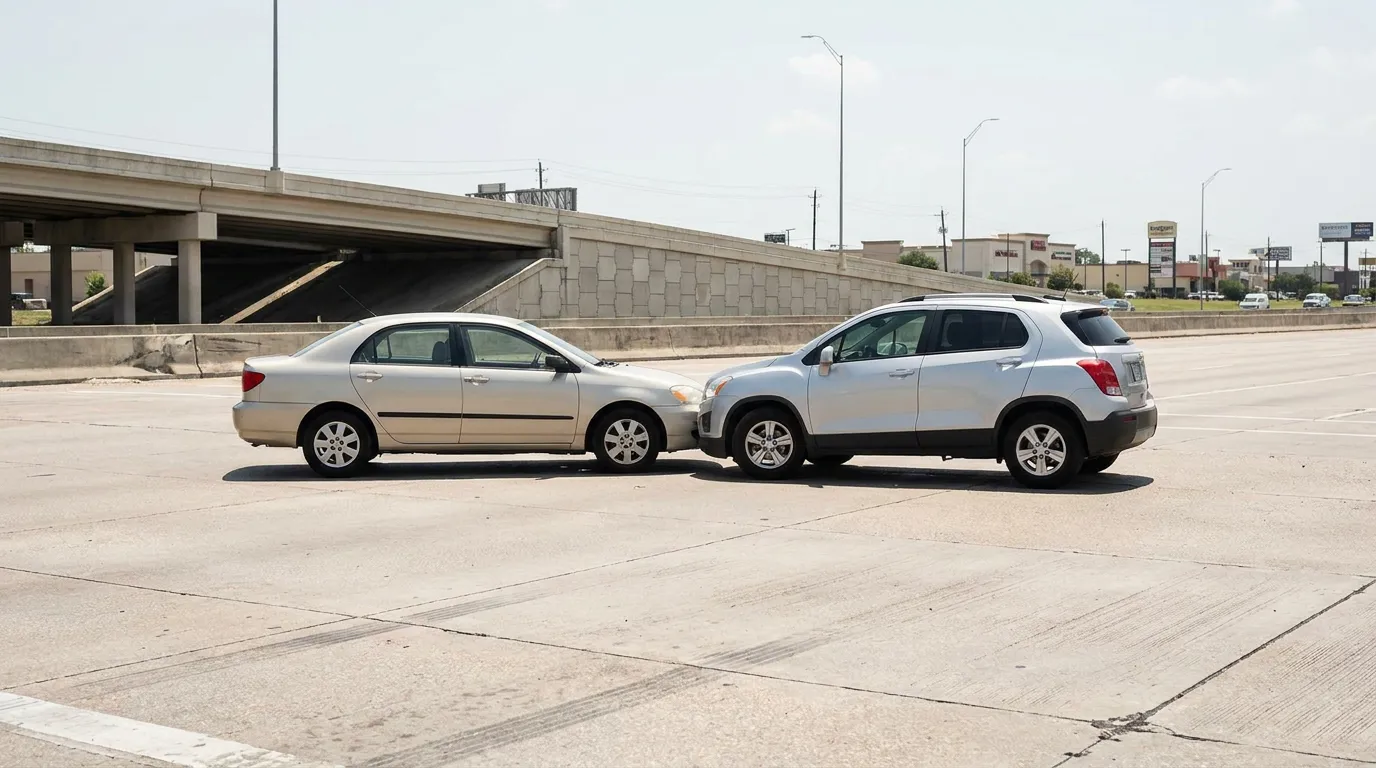
Understanding Feeder Road Collisions in Houston
Key Takeaways: In a Houston feeder road T-bone accident, fault generally rests with the driver who failed to yield the right-of-way under Texas Transportation Code §§ 545.153 and 545.154. At yield-sign-controlled intersections, a collision following a failure to yield serves as prima facie evidence of negligence under § 545.153(d), and a citation under § 542.4045 strengthens an injury claim. Texas uses proportionate responsibility, allowing partially at-fault victims to recover damages unless their share exceeds 50 percent. Crashes involving commercial vehicles add employer liability layers under respondeat superior, and victims generally have two years to file suit.
Fault in a feeder road T-bone accident in Houston generally falls on the driver who failed to yield the right-of-way. Feeder roads run parallel to Houston’s freeways and feed traffic on and off ramps at busy intersections. When a driver enters or crosses without yielding and strikes another vehicle’s side, Texas law often treats that collision as strong evidence of breach of duty. Still, side-impact crashes are rarely simple, and fault can be shared.
If you were hurt in a side-impact crash on a Houston frontage road, the team at Payne Law Firm treats clients like family and offers free consultations. Call us at 713-223-5100 or reach out through our online contact page.
How Texas Determines T Bone Accident Fault Houston Drivers Face
Determining t bone accident fault Houston victims face begins with duty and right-of-way. Texas assigns each driver a legal duty to yield in specific situations, and breach of that duty causing a collision can establish negligence. The Texas Transportation Code outlines these duties in detail.
At intersections controlled by stop or yield signs, common where feeder roads meet surface streets, the law is direct. Under the state’s right-of-way rules for drivers, Tex. Transp. Code § 545.153 requires a driver at a stop-sign-controlled intersection to yield to vehicles already in the intersection or approaching as an immediate hazard, and requires a driver at a yield-sign-controlled intersection to slow to a reasonable speed and yield to vehicles in the intersection or approaching closely enough to be an immediate hazard. Under § 545.153(d), if a driver required to yield at a yield sign drives past that sign without stopping and is then involved in a collision, that collision is prima facie evidence of failure to yield.
💡 Pro Tip: Photograph traffic control devices at the scene if you safely can. A picture of a yield or stop sign controlling the other driver’s approach can become powerful evidence.
The Feeder Road Yield Rule
Texas law specifically addresses who must yield on feeder roads. Tex. Transp. Code § 545.154 provides that a driver on an access or feeder road of a controlled-access highway must yield the right-of-way to a vehicle entering or about to enter the feeder road from the highway, or leaving or about to leave the feeder road to enter the highway. This rule is often decisive when a T-bone happens where a feeder road meets ramps or cross streets.
Investigators frequently examine the exact positions and movements of each vehicle. A frontage road T-bone near an on-ramp or off-ramp can turn entirely on which driver was entering the roadway and which was already established in the lane.
Uncontrolled Intersections and Presumptions
Not every Houston intersection has a working signal or clearly marked sign. For uncontrolled or signal-out intersections, Tex. Transp. Code § 545.151 sets a hierarchy: drivers must yield according to traffic-control devices, and where none exists, yield to vehicles on the right or on the through roadway. Subsection (f) provides that an operator required to stop and yield who is involved in a collision is presumed not to have yielded.
That presumption can be significant but is not automatic proof. Presumptions can be rebutted with evidence, and courts may consider factors like speed, visibility, and whether the other driver contributed to the crash.
Failure to Yield and Its Consequences
A citation for failure to yield can carry real weight in a civil claim. Tex. Transp. Code § 542.4045 makes a failure to yield right-of-way resulting in a collision punishable by a fine of $500 to $2,000 if another person suffered bodily injury, and $1,000 to $4,000 for serious bodily injury.
That fine is a traffic penalty, not compensation to the victim. However, a citation issued to the other driver can serve as strong evidence of negligence when you pursue a fault-based injury claim. Our guide on how to prove fault in a T-bone accident breaks down the process step by step.
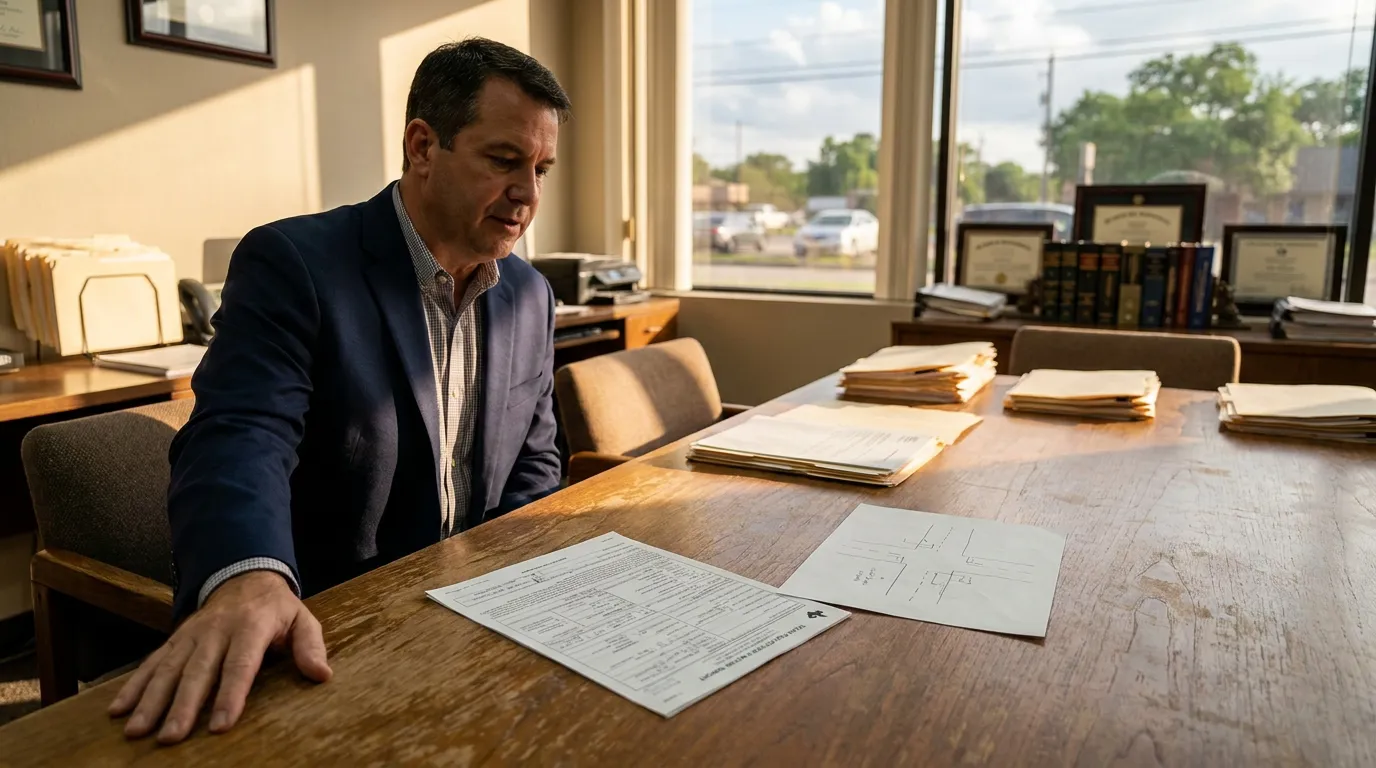
💡 Pro Tip: Request a copy of the Texas Peace Officer’s Crash Report (CR-3). It often documents citations, driver statements, and the officer’s diagram of the impact.
Shared Fault and Proportionate Responsibility
Texas does not use contributory negligence, so being partly at fault does not automatically end your claim. The state applies proportionate responsibility, codified in Chapter 33 of the Texas Civil Practice and Remedies Code. Judges and juries determine each party’s percentage of fault and reduce a claimant’s recoverable damages by that percentage.
Under the proportionate responsibility statute, Tex. Civ. Prac. & Rem. Code § 33.001, a claimant may not recover damages if their percentage of responsibility exceeds 50 percent. This 51% bar rule is often the decisive issue in disputed feeder road cases, and § 33.012 reduces a recovering claimant’s damages by their assigned share.
| Claimant’s Percentage of Fault | Effect on Recovery Under Chapter 33 |
|---|---|
| 0%, 50% | May recover, reduced by their own percentage |
| More than 50% | Barred from recovering any damages |
Insurers often try to inflate a victim’s share of fault to shrink a payout. Adjusters sometimes exploit the proportionate responsibility framework by assigning you a higher percentage of fault to lower what they pay. Being aware that fault percentages can be contested helps you push back.
💡 Pro Tip: Avoid giving a recorded statement to the other driver’s insurer before speaking with counsel. Casual remarks can be reframed to increase your assigned percentage of fault.
When a Commercial Vehicle Is Involved
A feeder road T-bone involving a commercial truck or company vehicle can change how you pursue the claim. Under Tex. Civ. Prac. & Rem. Code § 72.054(a), an employer defendant’s liability for damages caused by the ordinary negligence of a person operating its commercial motor vehicle is based on respondeat superior when the employer stipulates that the driver was its employee acting within the scope of employment.
Commercial cases can involve additional records, corporate policies, and insurance layers, and the facts of employment and scope of work often become central.
Filing Deadlines You Cannot Ignore
Texas gives accident victims a limited window to take legal action. According to TexasLawHelp.org, the statute of limitations for personal injury and property damage claims in Texas is generally two years. In general, a car accident victim has two years from the date of the crash to file suit.
Missing that deadline can be devastating. If you do not file within the limitations period, you will likely be unable to pursue your claim in court. Certain exceptions may pause or extend a deadline in limited circumstances, but courts interpret those exceptions narrowly, and they do not apply automatically.
Common challenges Houston victims face include:
- Insurers delaying negotiations until the deadline is close
- Difficulty locating witnesses to a fast-moving side-impact crash
- Disputes over which driver held the right-of-way at a feeder road ramp
- Rising medical bills and lost wages while a claim is pending
Why Legal Guidance Matters After a Side-Impact Crash
Sorting out Texas car accident liability on a busy Houston frontage road takes careful investigation. For more than 20 years, Payne Law Firm has helped over a thousand injured individuals and families seek the compensation they deserved. Attorney Jason Payne is Board Certified in Personal Injury Trial Law by the Texas Board of Legal Specialization.
If you are searching for a dedicated Houston car accident attorney, the firm focuses on helping injured Houstonians feel heard, informed, and respected. Understanding t bone accident fault Houston claims involve, preserving evidence early, and meeting deadlines all shape the strength of your case.
💡 Pro Tip: Seek medical care promptly even if you feel fine. Gaps in treatment give insurers an argument that your injuries were minor or unrelated to the crash.
Frequently Asked Questions
Who is usually at fault in a feeder road T-bone accident?
The driver who failed to yield the right-of-way is generally at fault. Under Tex. Transp. Code §§ 545.153 and 545.154, drivers must yield in defined situations. At yield-sign-controlled intersections, a collision after driving past a yield sign without stopping can serve as prima facie evidence of fault under § 545.153(d).
Can I still recover damages if I was partly to blame?
Yes, as long as your share of fault is 50 percent or less. Tex. Civ. Prac. & Rem. Code § 33.001 bars recovery only when a claimant’s responsibility exceeds 50 percent. Within the threshold, your damages are reduced by your assigned percentage.
How long do I have to file a claim after a Houston car accident?
Texas generally allows two years from the date of the crash. The limitations periods are set out in the Texas Civil Practice and Remedies Code and depend on the type of claim. Acting promptly is wise.
Does a traffic ticket prove the other driver was negligent?
A citation does not automatically establish civil liability, but it can be persuasive evidence. A failure-to-yield citation under Tex. Transp. Code § 542.4045 can support a negligence claim. Courts and juries still weigh all the evidence.
What if a company truck hit me on the feeder road?
Claims against commercial drivers may involve their employer through respondeat superior. Tex. Civ. Prac. & Rem. Code § 72.054(a) governs when employer liability rests on that doctrine. These cases can involve added records and insurance considerations.
Moving Forward After Your Feeder Road Crash
Fault in a Houston feeder road T-bone collision comes down to who breached their duty to yield and how proportionate responsibility rules apply. Right-of-way statutes, presumptions at uncontrolled intersections, failure-to-yield penalties, and the 51% bar rule all shape the outcome. The strength of your claim depends on careful investigation and timely action.
You deserve to feel supported after a serious side-impact crash. Reach out to Payne Law Firm for a free consultation with a team that treats clients like family. Call 713-223-5100 today or send us a message through our confidential case review form to take the first step toward the compensation you deserve.