
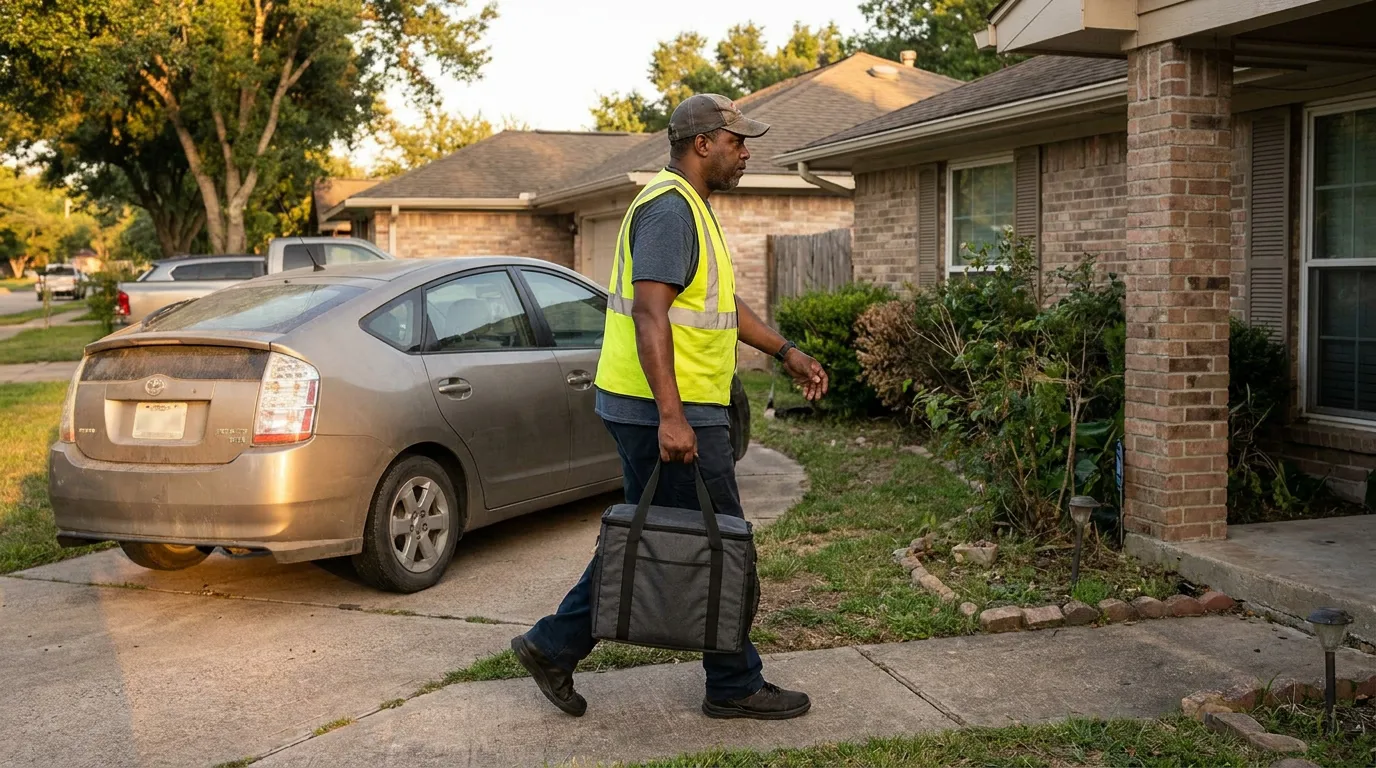
Why a Driver’s App Status Can Change Everything About Your Case
Key Takeaways: If an Uber Eats driver was on an active delivery in Houston when the crash occurred, the highest tier of available coverage, commonly a $1 million aggregate liability limit, generally applies, rather than the far lower $50,000/$100,000/$25,000 limits that typically apply when a driver is only logged on and waiting for a request. Those figures come from Texas’s transportation network company (TNC) insurance statute, Tex. Ins. Code §§ 1954.052 and 1954.053, which governs drivers providing prearranged passenger rides; food delivery generally falls outside that statute, so coverage for a delivery-only trip usually comes from the platform’s own contingent commercial policy, typically written in similar tiers. Because this distinction can dramatically change available funds, proving the driver’s app status at impact is a top priority in any delivery crash claim. For rides covered by the TNC chapter, Tex. Ins. Code § 1954.154 requires the company and its insurer to assist in claim investigations, including providing the driver’s log-on and log-off times for the 12 hours before and after the collision; similar records can often be obtained in delivery cases through claim requests or discovery. Coverage alone isn’t enough, you must still prove duty, breach, causation, and damages, and other parties may share responsibility. Texas generally allows two years to file suit under Tex. Civ. Prac. & Rem. Code § 16.003, with wrongful death claims running from the date of death and only narrow exceptions available. Acting quickly matters because app logs, vehicle data, and surveillance footage are often overwritten within weeks.
If an Uber Eats driver was on an active delivery when they hit you, the highest tier of commercial coverage available through the app may apply. Delivery platforms typically structure their contingent commercial policies along the same lines Texas uses for rideshare drivers, so available coverage depends largely on what the driver was doing at the moment of impact. That detail, logged in Uber’s system down to the minute, often determines whether you’re looking at a modest personal policy or a $1 million commercial policy.
At Payne Law Firm, we understand how confusing it feels when an insurance adjuster starts talking about "periods" and "app status" while you’re recovering from a serious injury. Our team treats clients like family, explains every step in plain language, and offers free consultations to Houston families. Call 713-223-5100 or reach out to our team today to talk through what happened.
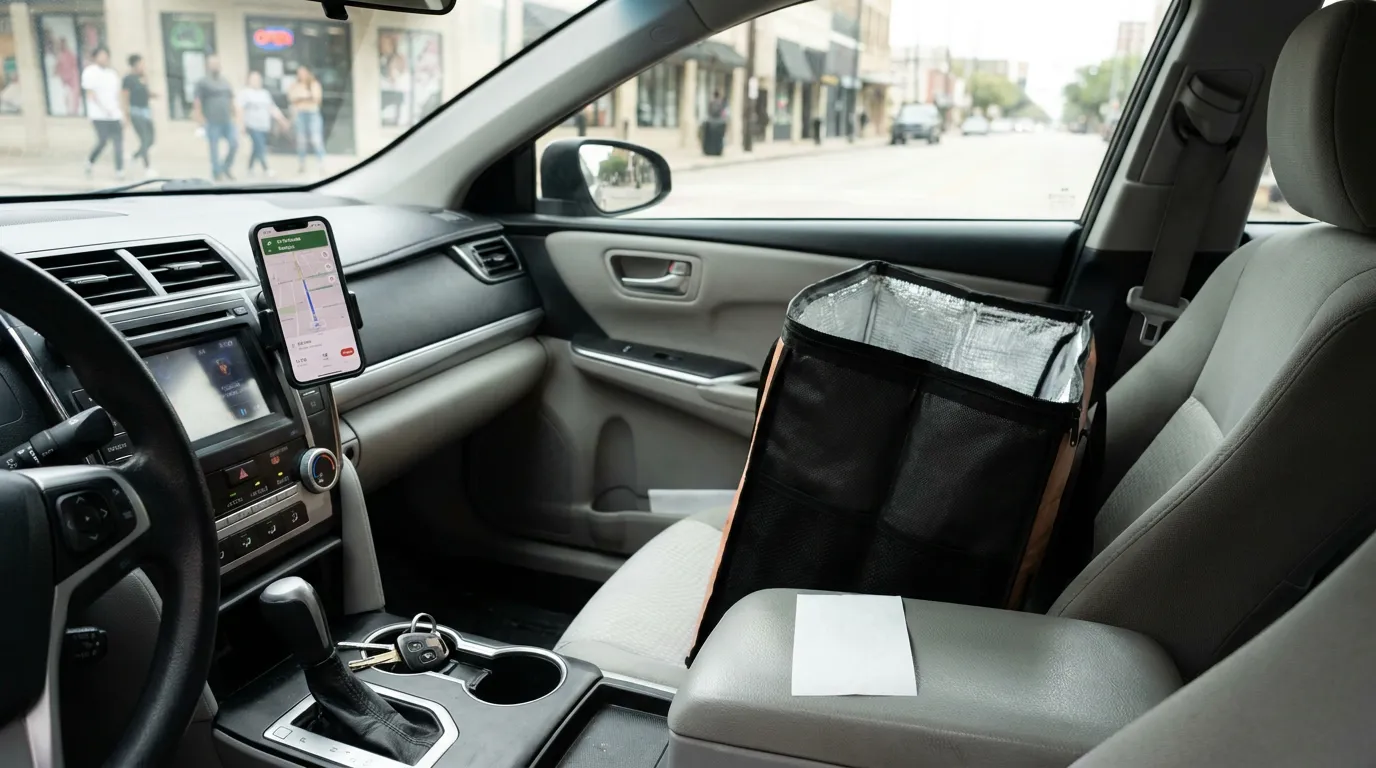
How Texas Law Defines a Delivery Driver’s Status
Texas regulates app-based drivers through its transportation network company statute in the Texas Occupations Code. Under Tex. Occ. Code § 2402.001, a "transportation network company" connects passengers with drivers for digitally prearranged rides, and § 2402.101 requires the driver, or the company on the driver’s behalf, to maintain coverage meeting Tex. Ins. Code Chapter 1954. That chapter draws a firm line between a driver merely logged on and one engaged in a prearranged ride. Because the statute is written around passenger rides, a food-delivery-only trip generally falls outside it, and the analysis usually turns on the platform’s own policy terms, which commonly track the same two-tier structure.
That line matters because available coverage changes dramatically depending on which side of it the driver falls. The same collision can produce very different insurance outcomes depending on whether the driver had already accepted an order, making the active delivery period a first priority in any careful investigation.
Period 1: Logged On but Waiting
When a driver has the app open but hasn’t yet accepted an order, the lower coverage tier generally applies. Under Tex. Ins. Code § 1954.052, the TNC policy for a logged-on driver must provide at least $50,000 per person and $100,000 per incident for bodily injury or death, and $25,000 for property damage; delivery platforms commonly carry comparable contingent limits for this window. These limits often fall short of what a seriously injured person actually needs.
Periods 2 and 3: En Route and Actively Delivering
Once the driver accepts the order and begins traveling toward the restaurant or customer, coverage may improve substantially. Tex. Ins. Code § 1954.053 requires, for a driver engaged in a prearranged ride, a total aggregate liability limit of $1 million per incident, along with uninsured/underinsured motorist coverage under Tex. Ins. Code § 1952.101 and personal injury protection under § 1952.152. Delivery platforms generally provide a comparable $1 million third-party liability policy for the analogous delivery window, though the precise trigger is set by policy rather than statute. Review the full text of these Texas TNC insurance requirements in the Occupations Code.
This framework applies statewide, so an Uber Eats driver in Houston officially on an active delivery would generally fall under the highest available coverage tier. Harris County crashes are governed by the same statutory and policy structure as anywhere else in Texas. For more detail, see our article on the 4 insurance periods in a Houston Uber crash.
Comparing Coverage by App Status
| Driver Status | Statutory Minimum Coverage | Practical Effect on a Claim |
|---|---|---|
| App off (personal driving) | Personal auto policy only | No app-based coverage generally applies |
| App on, awaiting a request | $50,000 / $100,000 / $25,000 | Limited funds for serious injuries |
| Order accepted, en route | $1 million aggregate per incident | Substantially broader recovery potential |
| Actively delivering | $1 million aggregate per incident | Highest tier typically available |
Proving the Active Delivery Period in a Houston Uber Eats Accident Claim
The strongest evidence of a driver’s status generally comes from app data itself, and it can usually be obtained. Under Tex. Ins. Code § 1954.154, a TNC and its insurer must assist interested persons by providing the driver’s log-on/log-off times for the 12 hours before and after the accident. A driver must also disclose, on request under § 1954.056, whether they were logged on or engaged in a prearranged ride at the time of the collision. In a delivery-only case these statutes may not apply directly, but similar records are routinely obtained through claim demands, preservation letters, or discovery, and that log is frequently the deciding piece of evidence in a Houston food delivery crash.
This data doesn’t always arrive quickly or voluntarily. Insurers may initially characterize a driver as merely logged on rather than actively delivering, pointing toward lower limits. Requesting app records early, and preserving them through formal channels when necessary, can help protect your ability to challenge that characterization.
Evidence Worth Preserving Immediately
- Photographs of the driver’s vehicle, delivery bags, and the scene
- The Houston Police Department crash report and responding officer’s notes
- Names and contact information for witnesses who saw the driver’s phone
- Restaurant or customer confirmation of an order near the time of the crash
- All medical records, bills, and documentation of missed work
💡 Pro Tip: If you spoke with the driver after the crash and they mentioned an order, write down exactly what they said and when. Contemporaneous notes can corroborate app records.
Who May Be Held Responsible After a Delivery Crash
Liability generally turns on proving negligence, not simply on identifying which policy exists. You must still show the driver owed a duty, breached it, and caused your injuries and damages. Coverage tier may determine available funds; negligence determines whether recovery is possible at all.
Texas law also places compliance obligations on the network company rather than solely the individual driver. Tex. Occ. Code § 2402.101 incorporates the requirements of Texas Insurance Code Chapter 1954 by reference, applying them to transportation network companies and drivers logged in to a digital network. It is Tex. Ins. Code § 1954.051 that specifically places the insurance maintenance obligation on the TNC driver or the transportation network company on the driver’s behalf during defined periods of digital network use, ensuring compliance obligations extend to the company and not solely the individual driver. At the same time, § 2402.114 provides that drivers meeting certain conditions are treated as independent contractors rather than employees, which can limit vicarious liability theories. Whether a company may be held liable in a given case is fact-dependent and subject to legal defenses, so no outcome should be assumed.
Other parties may share responsibility depending on the facts, including a third motorist, a vehicle owner, or a party responsible for a hazardous road condition. Our Houston Uber Eats accident claim lawyer team evaluates every potential source of recovery rather than stopping at the first policy identified.
Deadlines That Can Quietly End a Claim
Texas generally imposes a two-year deadline for filing suit after a delivery crash. Tex. Civ. Prac. & Rem. Code § 16.003(a) requires suit for personal injury or property injury not later than two years after the cause of action accrues. Missing that window can bar recovery entirely, regardless of how strong the underlying facts are.
Wrongful death claims follow a related but distinct accrual rule. Tex. Civ. Prac. & Rem. Code § 16.003(b) provides that the limitations period runs from the death of the injured person rather than from the date of the underlying injury. Families sometimes misunderstand this distinction during an already painful time.
When Exceptions May Apply
Certain narrow doctrines can, in limited circumstances, affect when the clock begins or pauses. The discovery rule and various tolling provisions may apply where an injury was inherently undiscoverable, or where a claimant was a minor or legally incapacitated. Texas courts generally interpret these exceptions narrowly, and none should be assumed to apply automatically.
Claims involving a governmental entity follow separate administrative notice requirements that are typically far shorter and operate independently of the two-year rule. A general overview of civil filing deadlines in Texas can be useful background, though it doesn’t substitute for review of your specific circumstances.
💡 Pro Tip: Do not wait for the two-year mark to act. Evidence such as app logs, vehicle data, and surveillance footage is often overwritten within weeks.
Frequently Asked Questions
1. Does it matter whether the driver had the food in the car yet?
Generally, the higher coverage tier may apply once a driver has accepted an order and is engaged in the trip, which can include traveling to pick up the food, per how Tex. Ins. Code § 1954.053 treats an accepted prearranged ride. Whether a specific moment qualifies depends on policy language and can still be disputed, and app logs often help resolve it.
2. What if the driver claims the app was off at the time?
App records showing precise log-on and log-off times surrounding the crash can usually be obtained from the delivery company or its insurer, by statute in TNC passenger cases under Tex. Ins. Code §§ 1954.056 and 1954.154, and through claim requests or discovery in delivery cases. That record often contradicts an inaccurate account of the driver’s status.
3. Can I recover if I was a pedestrian or cyclist rather than a motorist?
Potentially, yes. Pedestrians, bicyclists, occupants of other vehicles, and passengers may all be able to pursue claims after an Uber Eats delivery accident, provided negligence and damages can be established.
4. What happens if the $1 million policy does not cover all my losses?
Additional sources may exist, including uninsured/underinsured motorist coverage under Tex. Ins. Code § 1952.101, your own policy, or claims against other responsible parties. Each case depends on its own facts and available coverage.
5. How soon should I contact an attorney after a Houston Uber Eats injury claim arises?
As soon as reasonably possible. Early involvement can help preserve app data, witness accounts, and medical documentation before they become unavailable.
Moving Forward After a Delivery Driver Crash
Understanding food delivery app coverage in Texas is not academic when you’re facing medical bills, lost income, and an insurer questioning your account. The difference between a driver waiting for a request and one actively delivering can mean the difference between $50,000 in available coverage and $1 million. Establishing that status, documenting your losses thoroughly, and filing within the statutory deadline are practical steps that may help protect a claim. Outcomes always depend on the specific facts and governing policy language, and no two collisions produce identical results.
Attorney Jason E. Payne is Board Certified in Personal Injury Trial Law by the Texas Board of Legal Specialization, and for more than 20 years Payne Law Firm has helped over a thousand injured individuals and families across Houston pursue compensation for their losses. We take our neighbors seriously, explain the process clearly, and fight for people who feel overlooked by insurance companies. Call 713-223-5100 or schedule your free consultation today.
Disclaimer: This content is for informational purposes only and is not legal advice. Every case is unique, and results may vary. Consult an attorney about your specific circumstances.