
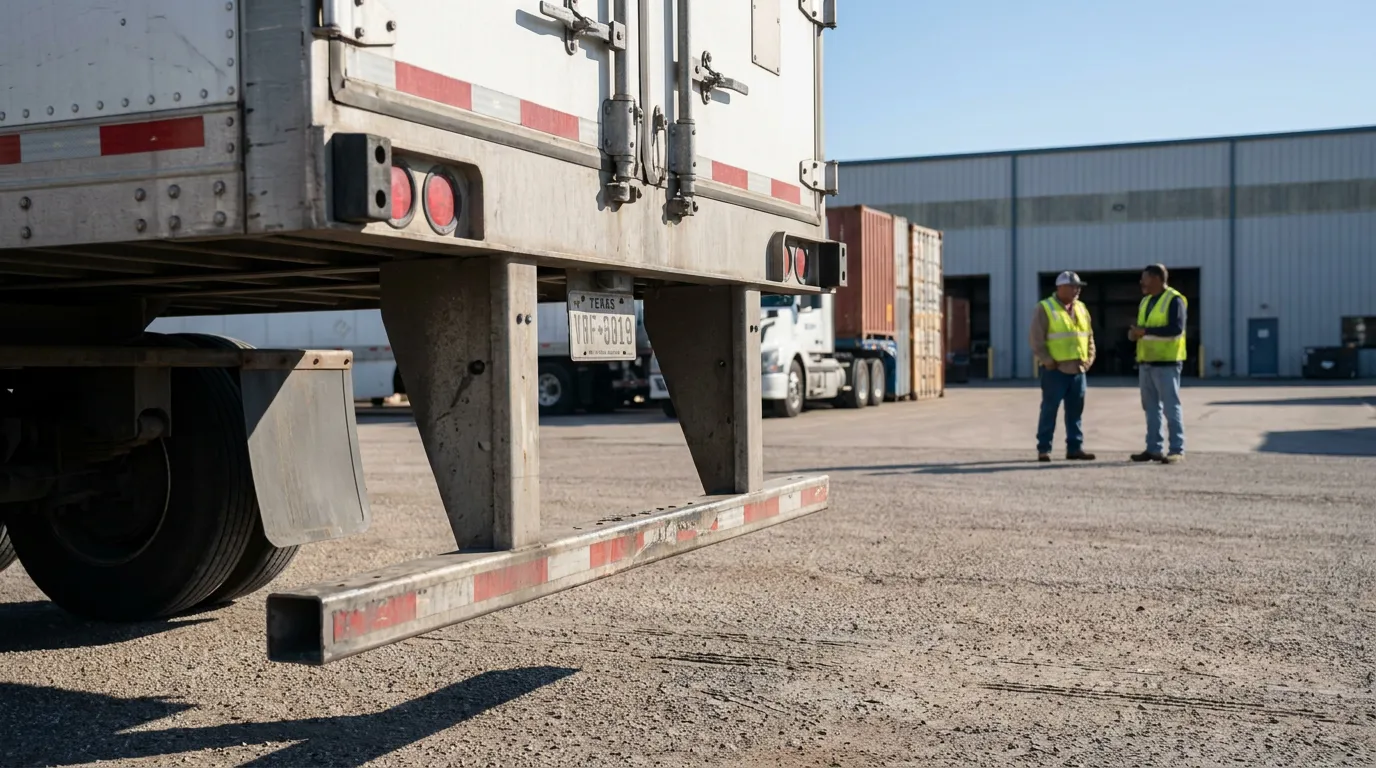
The Federal Rear Guard Rule Behind Many Houston Underride Cases
Key Takeaways: FMVSS 223 sets federal performance requirements for rear impact guards on trailers, while FMVSS 224 requires installation on most newly manufactured trailers with a GVWR of 10,000 lbs or more. When guards are missing, corroded, or damaged, survivable crashes can become catastrophic. Texas separately requires safety guards or flaps under Tex. Transp. Code § 547.606. Responsibility may extend to the motor carrier, maintenance shops, or trailer manufacturer. Texas modified comparative fault under Chapter 33 allows recovery when a claimant is 50 percent or less at fault. Most claims must be filed within two years under § 16.003.
FMVSS 223 is the federal motor vehicle safety standard that sets strength and performance requirements for rear impact guards on trailers and semitrailers: the horizontal steel bars mounted beneath the back of an 18-wheeler to stop a passenger car from sliding underneath in a rear-end collision. FMVSS 224 generally obligates manufacturers to install conforming guards on most trailers built on or after January 26, 1998, with exclusions for pole trailers, pulpwood trailers, and certain other categories. When a guard is weak, corroded, or improperly mounted, a survivable crash can turn catastrophic because the car’s crumple zones and airbags may never engage. For Houston families, understanding the fmvss 223 underride guard requirements matters because guard failure can point to liability beyond the truck driver, potentially reaching the motor carrier and trailer manufacturer.
If you or someone you love was hurt in a crash involving an 18-wheeler rear guard, the team at Payne Law Firm is here to listen. Call 713-223-5100 or reach out for a free consultation to talk through what happened, with no pressure and no obligation.
What a Rear Impact Guard Is Supposed to Do
A rear impact guard is intended to keep a passenger vehicle from traveling underneath the trailer’s rear frame. Trailers sit high off the pavement, and a car’s bumper may pass beneath the trailer bed entirely if nothing blocks it. The result can be intrusion into the passenger compartment at head and chest level, which is why underride collisions may produce disproportionate injuries.
The federal standard sets minimum strength and dimensional criteria for the guard itself. A guard that meets standards when manufactured may fail years later after rust, collision damage, or improvised repairs. Federal safety standards address manufacturers, while a motor carrier’s duties come from the Federal Motor Carrier Safety Regulations, including inspection, repair, and maintenance rules in 49 C.F.R. Part 396. The litigation question is often not whether a guard existed, but whether it performed as a reasonably maintained guard should have.
Determining compliance is fact-intensive. Accident reconstructionists, metallurgical engineers, and maintenance records often drive the analysis. Outcomes depend on the specific trailer, its age and applicable standards, service history, and impact physics.
Texas Adds Its Own Trailer Safety Requirements
Texas law independently addresses rear safety equipment on large trucks and trailers. Under Tex. Transp. Code § 547.606(a), a road tractor, truck, trailer, or semitrailer combination with at least four tires or two super single tires on the rearmost axle must be equipped with safety guards or flaps prescribed by the department. This requirement targets guards behind the wheels rather than underride protection, supplementing federal rear impact guard standards.
The statute specifies placement. Section 547.606(a)(2) requires guards or flaps located behind the rearmost wheels within eight inches of the highway surface. You can review the Texas vehicle equipment statute to confirm the current version.
Exceptions matter. Tex. Transp. Code § 547.606(b) provides the section does not apply to a truck-tractor operated alone or to a pole trailer. Whether a violation constitutes negligence per se depends on how a Texas court applies the statute to the particular injury and injured person.
How Vehicle Classification Affects the Analysis
Whether a particular rig falls within these obligations depends on how Texas defines the vehicle. For example, Tex. Transp. Code § 545.307(a)(1) defines "commercial motor vehicle" for following-distance provisions by referencing Section 522.003 and Section 541.201 definitions. These definitions are section-specific, so counsel must confirm which definition governs the particular rule.
Who May Be Held Responsible After an Underride Crash
Liability may extend past the driver. An employer may be vicariously liable under respondeat superior for an employee driver’s negligence and may face direct claims for negligent hiring, training, supervision, entrustment, or maintenance. Tex. Civ. Prac. & Rem. Code Chapter 72 sets out procedures, such as bifurcation, that apply when an employer is sued with its commercial driver.
Depending on the facts, several parties may share responsibility:
- The driver, for following distance, lane changes, or lighting failures
- The motor carrier, for inspection, maintenance, and supervision practices
- Maintenance shops that serviced or modified the trailer
- The trailer manufacturer, where a design or manufacturing issue is alleged
Sorting out responsibility is rarely obvious. Trailer ownership, leasing arrangements, and brokered loads can obscure the chain of responsibility. Early investigation, evidence preservation, and trailer inspection can be critical.
💡 Pro Tip: Photograph the rear of the trailer, including the guard, mounting brackets, and DOT markings, if safe to do so. Trailers can be repaired or returned to service quickly.
Applying Fmvss 223 Underride Guard Requirements to Fault Disputes
Insurers commonly argue the smaller vehicle’s driver caused the crash. Texas applies modified comparative fault under Tex. Civ. Prac. & Rem. Code § 33.001, which bars recovery if a claimant’s responsibility exceeds 50 percent. A Houston plaintiff alleging a noncompliant rear guard may still recover if assigned 50 percent or less of the fault.
Chapter 33 allocates responsibility among claimants, defendants, settling parties, and responsible third parties. In underride cases, that may mean apportionment among the truck driver, motor carrier, and trailer manufacturer. The proportionate responsibility statute sets out that framework.
Within the threshold, comparative fault reduces recovery rather than eliminating it. Under § 33.012, the court reduces damages by the claimant’s percentage of responsibility, so a 40 percent plaintiff would recover 60 percent of damages.
Deadlines That Can End a Strong Case Before It Starts
Even compelling guard-failure cases can be lost on timing. Under Tex. Civ. Prac. & Rem. Code § 16.003(a), a person generally must bring suit for personal injury not later than two years after the cause of action accrues. This basic two-year period is settled law, though tolling provisions for minors and persons under legal disability under § 16.001 can change the calculation.
| Claim Type | General Texas Deadline | When the Clock Starts |
|---|---|---|
| Personal injury (§ 16.003(a)) | Two years | Day cause of action accrues |
| Property damage (§ 16.003(a)) | Two years | Day cause of action accrues |
| Wrongful death (§ 16.003(b)) | Two years | Death of injured person |
The same two-year period covers property damage claims alongside bodily injury claims from the same collision.
Wrongful Death Timing Is Measured Differently
In fatal Houston underride crashes, the two-year clock runs from a different starting point. Tex. Civ. Prac. & Rem. Code § 16.003(b) provides that a suit for injury resulting in death must be brought within two years and accrues on the death of the injured person. This distinction matters when a victim survives weeks or months after the collision.
Tolling and discovery arguments exist, but Texas courts interpret them narrowly. They do not apply automatically. Claims involving governmental entities face short notice deadlines under the Texas Tort Claims Act, distinct from civil statutes of limitations.
💡 Pro Tip: Do not wait for the police report or insurer’s investigation before speaking with an attorney. Evidence preservation letters generally need to go out long before lawsuit filing.
Practical Steps While the Claim Is Pending
What you do after a crash can shape available evidence. Follow through with medical treatment and keep records of appointments, prescriptions, and missed workdays. Save repair estimates, towing receipts, and scene photographs.
Be cautious with recorded statements and early settlement offers. Adjusters may seek statements before the full extent of injuries is known. A Houston truck accident attorney can help you understand what you are obligated to provide.
Frequently Asked Questions
1. Does a rear guard that met FMVSS 223 when new mean the trucking company is off the hook?
Not necessarily. Compliance at manufacture is one issue; condition and maintenance at the crash is another. Corrosion, prior damage, and improper repairs are frequently examined.
2. Can I still recover if the police report suggests I was partly at fault?
Possibly, yes. Under Texas modified comparative fault, a claimant whose responsibility is 50 percent or less may recover, with damages reduced by that percentage. Police reports are not admissible as binding fault determinations.
3. What if the trailer was owned by a company different from the trucking carrier?
That is common. Trailers are frequently leased, interchanged, or pulled under brokered arrangements. Identifying the correct owner and maintenance provider is part of the investigation. Multiple entities may bear responsibility.
4. Do Texas rear guard rules apply to every big truck?
No. Tex. Transp. Code § 547.606(b) excludes truck-tractors operated alone and pole trailers from state requirements, and FMVSS 224 excludes several trailer categories. Whether a rule applies depends on vehicle configuration, axle setup, and manufacture date.
5. How long do I have to bring a claim after a Houston underride crash?
Generally two years, subject to exceptions. The period runs from accrual for injury claims and from death date for wrongful death claims, with different deadlines when governmental entities are involved. Act early rather than rely on exceptions.
Where Federal Standards and Texas Law Meet
Underride collisions sit at the intersection of federal equipment standards, Texas trailer safety statutes, proportionate responsibility rules, and strict filing deadlines. The federal rear impact guard standards supply the engineering benchmark, Texas Transportation Code § 547.606 supplies a separate state-law requirement, and Chapter 33 governs how fault is divided. Every case turns on its facts, including trailer condition, crash dynamics, and evidence preserved early. If you want to keep learning about truck safety regulation liability, our library covers related topics.
For more than 20 years, Payne Law Firm has stood beside injured Houstonians and grieving families, and Attorney Jason E. Payne is Board Certified in Personal Injury Trial Law by the Texas Board of Legal Specialization. A native of Port Arthur, he built this practice around helping people feel heard, informed, and respected during some of the hardest moments of their lives, and the firm treats its clients like family. If a trailer’s rear guard may have played a role in your crash, talk with our Houston team by calling 713-223-5100 or visiting Payne Law Firm to schedule a free, no-obligation consultation.
Disclaimer: This content is for informational purposes only and is not legal advice. Every case is unique, and results may vary. Consult an attorney about your specific circumstances.